
Most people assume good companies produce good stock returns. Over long periods, that often proves true. However, over shorter periods, and even sometimes lasting years, strong businesses can underperform
while other areas of the market surge ahead.
Recent markets can provide a useful example. A handful of technology and AI-related companies have delivered exceptional returns, attracting much of the market’s attention. Yet beneath those headlines, many profitable, financially strong businesses have delivered solid operational results while their stocks have lagged significantly.
Understanding why this happens can help separate business performance from stock performance. While related, the two do not always move in tandem.
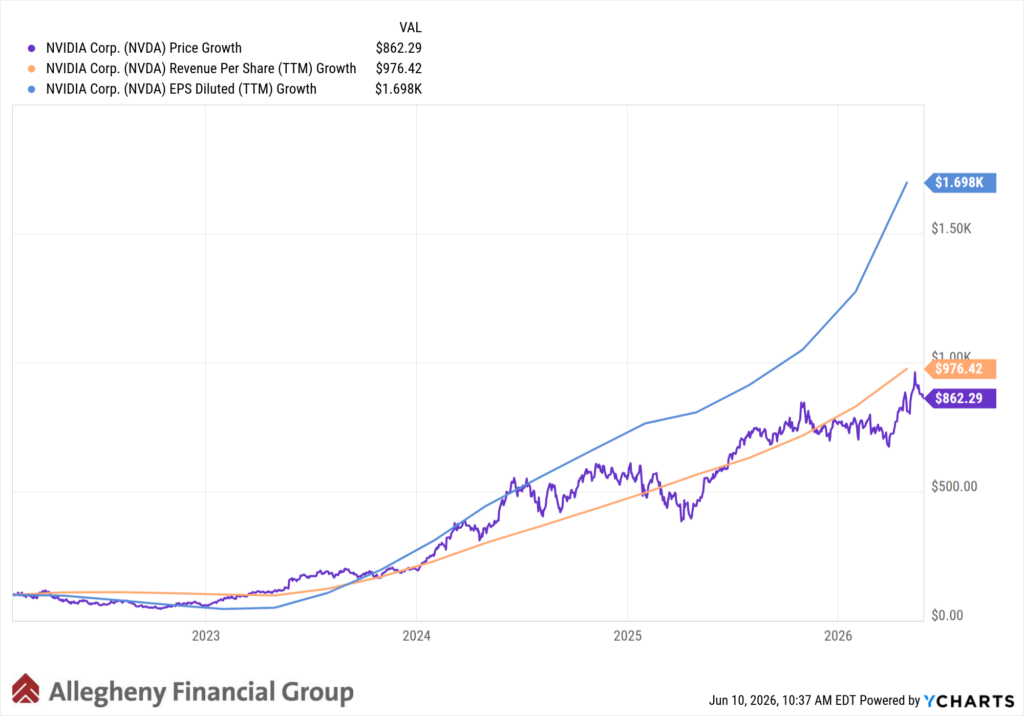
Exhibit 1: Nvidia
Source: YCharts as of June 10, 2026
Nvidia provides a clear example of a period where business execution and stock performance have moved together. Revenue and earnings growth accelerated dramatically as demand for AI infrastructure surged. In this case, strong fundamentals and market leadership reinforced one another.
However, strong business execution alone does not guarantee strong stock returns.
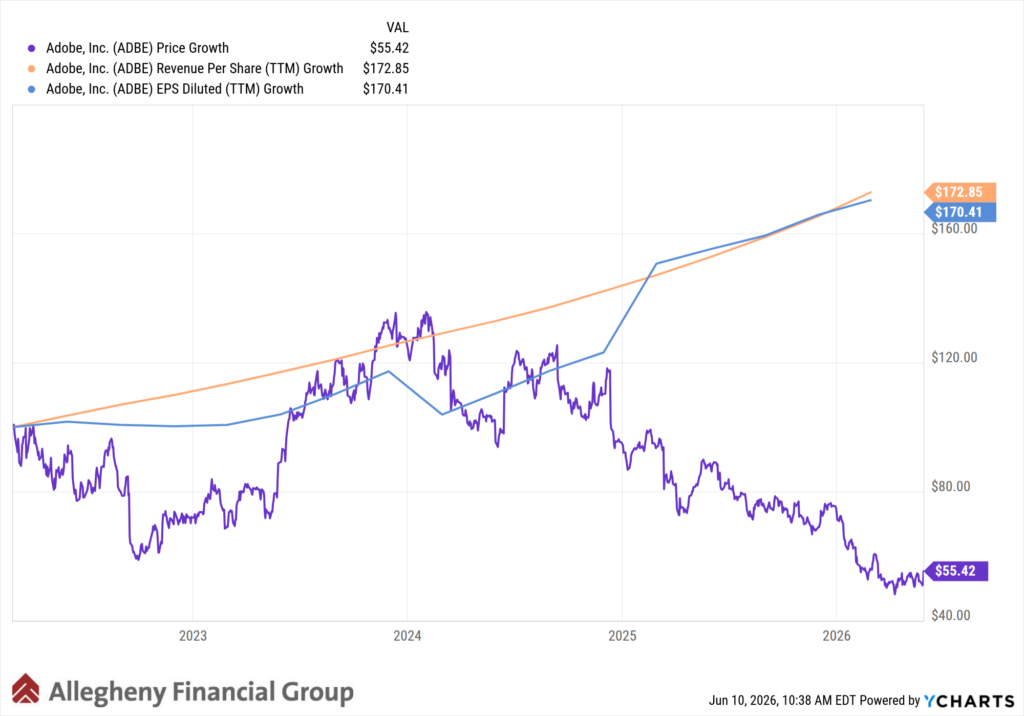
Exhibit 2: Adobe
Source: YCharts as of June 10, 2026.
Adobe provides a different example. Over the same period, the company continued to grow its revenue and earnings while maintaining its position as a leader in digital creative software. Despite solid operating results, the stock significantly underperformed. Investors became increasingly concerned about AI disruption and future growth prospects, causing sentiment to deteriorate even as the underlying business remained healthy.
These examples highlight an important distinction. Investors do not buy businesses in isolation; they buy expectations about future business performance. When expectations rise alongside improving fundamentals, stock returns can be extraordinary. When expectations fall, even strong companies can struggle to reward investors despite company-level success.
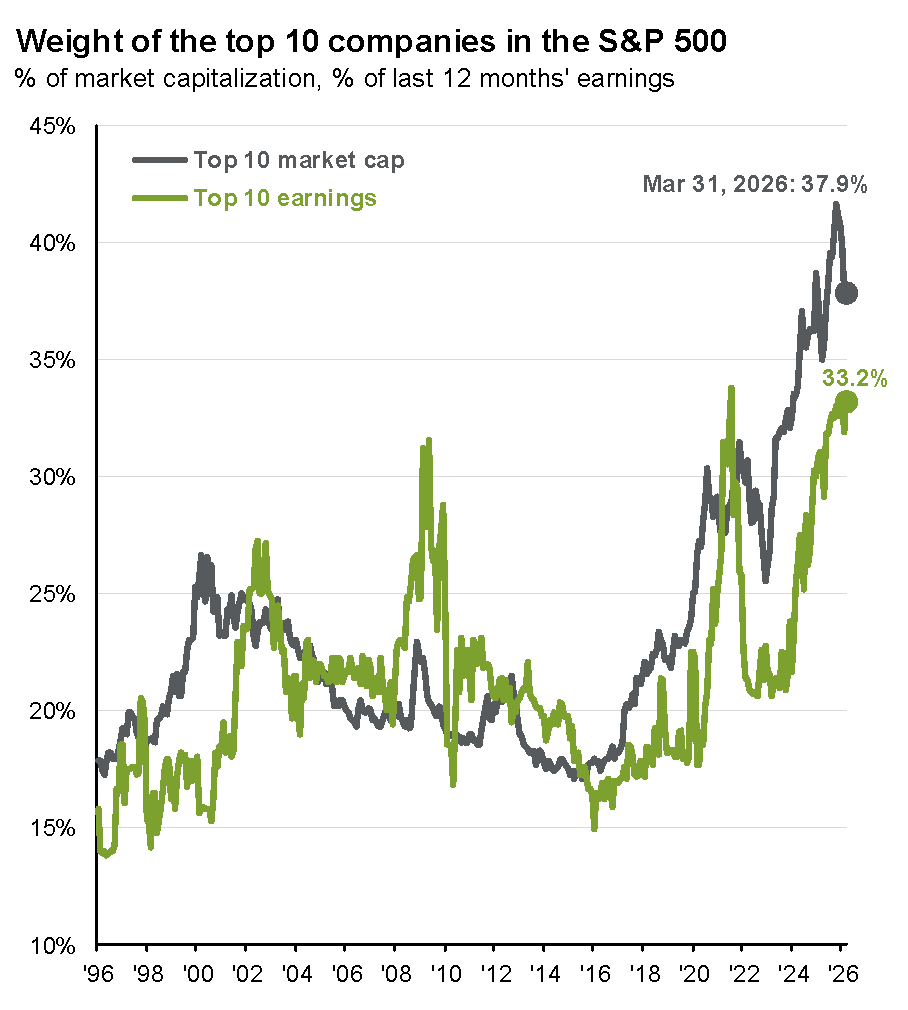
Nvidia and Adobe can serve as company-specific examples, but at the broader market level, a similar dynamic can emerge when capital becomes concentrated into a relatively small number of companies. As expectations rise and investors crowd into perceived winners, market leadership can narrow significantly.
Exhibit 3: Weight of the top 10 companies in the S&P 500
Source: JPMorgan Asset Management, Guide to the Markets, U.S. | 2Q2026, as of March 31, 2026.
The same forces that influence individual stock returns can also influence broader market leadership. While today’s market leaders have delivered strong business results, history suggests leadership is rarely permanent. Changes in expectations, valuations, and preferences have repeatedly changed which companies drive overall market returns.
Good businesses can temporarily become disappointing investments. Strong stock performance can sometimes occur before business fundamentals fully develop. Markets move through periods where expectations, sentiment, and leadership dynamics influence outcomes in ways that may not always align with underlying quality.
Over longer periods, distinguishing between changes in fundamentals and changes in market dynamics can help provide useful context. Understanding that difference may not eliminate periods of discomfort, but it can help provide perspective when strong businesses and strong stock returns move in different directions.