

Have you ever been discussing a purchase with your spouse or partner and suddenly found yourself feeling intensely angry, sad, or happy? Or does this conversation sound familiar?
- Person A: “Why is our credit card bill so high this month? I don’t know where our money goes.”
- Person B: “Groceries are really expensive, and the cat had to go to the vet last month.”
- Person A: “Well, I don’t know why you must go to the fancy grocery store. The discount grocery is only ½ a mile away. Why didn’t you go there?”
- Person B: “Don’t you think our kids deserve organic produce? Plus, the discount store doesn’t have roasted chickens, and it saves me time to buy them already cooked.”
- Person A: “I didn’t eat organic food, and I turned out fine. These kids don’t appreciate anything anyway. They think money grows on trees.”
While on the surface, this is a fight about groceries, it’s really a clash of money scripts. Money scripts are deeply ingrained beliefs about money that stem from our childhoods and that we probably don’t even know we have. These lessons may have been consciously instilled by our parents, or we may have unconsciously absorbed them by observing our parents’ behavior.
According to financial psychologists Drs. Brad and Ted Klontz, there are four types of money scripts: Money Avoidance, Money Worship, Money Status, and Money Vigilance.
Notice that in the argument above, the couple never said whether they could afford the expenses they were incurring; it was implied by Person A that they shouldn’t spend as much as they were. What if they had more than enough money to pay for the groceries? Person A was exhibiting “Money Vigilance,” or the belief that there will never be enough money and it should not be spent.
The good news is that money scripts can be changed and that examining your money scripts with your partner can help you both understand yourselves and each other better.
Money Avoidance
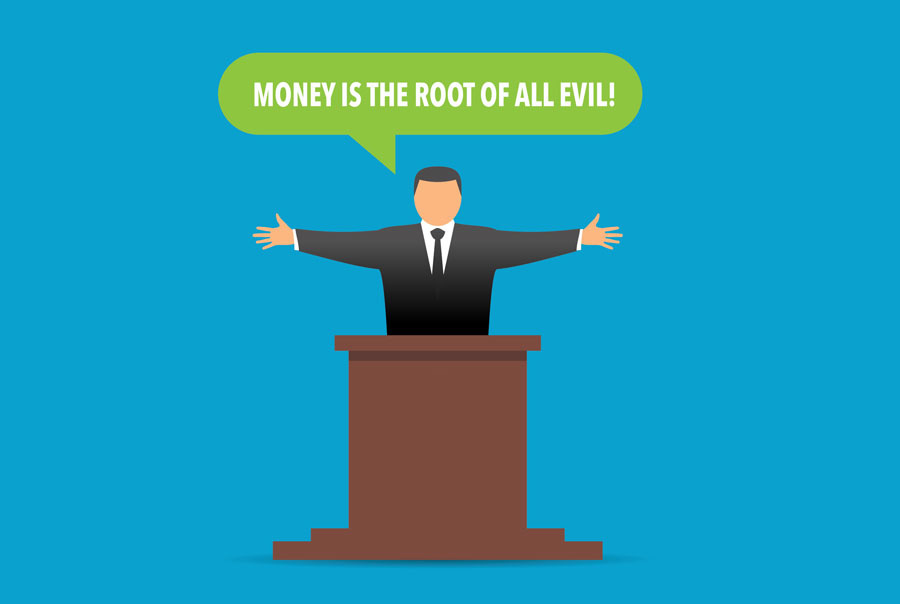
The first money script is called “Money Avoidance.” Although it may sound foreign, engaging with Money Avoidance is more common than you think. People with Money Avoidance scripts typically feel fear, disgust, or anxiety about money. They believe that money corrupts. They may label the wealthy as greedy, and think that they are better off having less money. It all comes back to the belief that money, and to a greater degree wealth, is inherently corrupt. These beliefs are often deeply ingrained and they have a real-life financial impact. Money Avoidance can lead people down a difficult path to financial denial and dysfunction. Many people with this belief feel deep down as if they don’t deserve money and wealth. Additionally, there may be unconscious anxiety about money that causes them to avoid thinking about their money, which can lead to overspending, missed payments, and monetary enabling.
Money Worship

“Money Worship” takes the understanding of the importance of money and financing to the extreme opposite side of the spectrum. People who engage in Money Worship believe money rules everything around them. That money holds power, therefore having more money means wielding more power. Unlike Money Avoidance, Money Worship can have a few benefits. We all need to acquire money to live and more so to live comfortably. However, a Money Worshipper doesn’t stop there. Many people who qualify as engaging in Money Worship use money to chase happiness. They believe contentment lies within the next thing or the next trip. They engage in compulsive spending and convince themselves that spending money on other people is a show of affection. Most of all, the mission to acquire more money and wealth is never-ending. That’s because they’re chasing something that doesn’t exist. Money will not solve all your problems. You’re more likely to end up with a lot of stuff and a lifelong belief that something better is just around the corner.
Money Status

“Money Status” is a close relative of “Money Worship.” Both assign power, gravitas, and importance to money and the people that have it. Whereas Money Worship is more externalized through the actions and recognition of money, Money Status is more internal. People who are subconsciously Money Status believers evaluate their own self-worth based on their net worth. They see material objects as another sign of worth. They too, like Money Worshippers, always need to have the next, newest Big Thing. The difference being that the material objects aren’t used for show with other people, rather it’s to convince themselves that they’re important and successful. Those big-ticket objects are used to prop up their own self-esteem. Not shockingly, people who fall into this category are frequently compulsive over-spenders due to their constant quest to show off. Compulsive gambling is also a common habit, as is hiding their spending habits and becoming financially dependent because they outspend their income. In that sense, the people who qualify as having this Money Script have the same symptoms of an addict. Albeit an addition to money.
Money Vigilance

Money Vigilance has the most positive attributes of all the Money Scripts. It is not without its drawbacks, however. While it’s important to be financially responsible, we don’t have to live life stressing over every penny. Someone who is overly Money Vigilant can be rigid about adages like “Money should be saved, not spent,” and “If you cannot pay cash for something, you should not buy it.” There’s nothing wrong with asking yourself these questions when trying to determine a financial decision, but it’s important to remember that you can and should spend your money responsibly. Yes, we would save money if we never went out to eat, never went on vacation, or went to see a sporting event. However, life is short and we should enjoy it while it’s here. In many cases, their stringent money-saving habits come from profound anxiety about money, and it’s what drives them to be so Vigilant. Like other Money Scripts, people who are Money Vigilant may find that they are never satisfied. No matter how much they save or earn, they may always worry that it isn’t enough.
Money Scripts Can Be Changed

It is possible to identify and to change one’s money scripts. Sometimes just realizing that a money script is limiting your choices can be enough to help you begin to “rescript” it. Just like any behavior, it can be unlearned. Through research conducted by Brad and Ted Klonz, Money Scripts and people’s relationship to them have a tangible impact on a person’s net worth, income, and overall financial health. Talk to a CERTIFIED FINANCIAL PLANNER® practitioner about what limiting beliefs may be holding you back.