
It’s FAFSA time. Here’s your student aid study guide.
If your high school student is college-bound, you’ve probably heard the term FAFSA. If not, you’re about to become quite familiar with it. FAFSA (Free Application for Federal Student Aid) is how the government determines a family’s eligibility for grants, work-study, loans, and other forms of student aid to pay for college. The FAFSA determines how much a family is expected to pay based on need or the Student Aid Index (SAI), which is a formula schools use to determine how much financial support you may need.
The FAFSA process can be daunting, but consulting a financial advisor can help alleviate the stress and perhaps save you money. This article discusses why everyone should fill out the FAFSA, how it looks at income level and student assets, the filing timeline, changes, and how you can increase your chances of receiving more grants, federal student aid, and other forms of student aid.
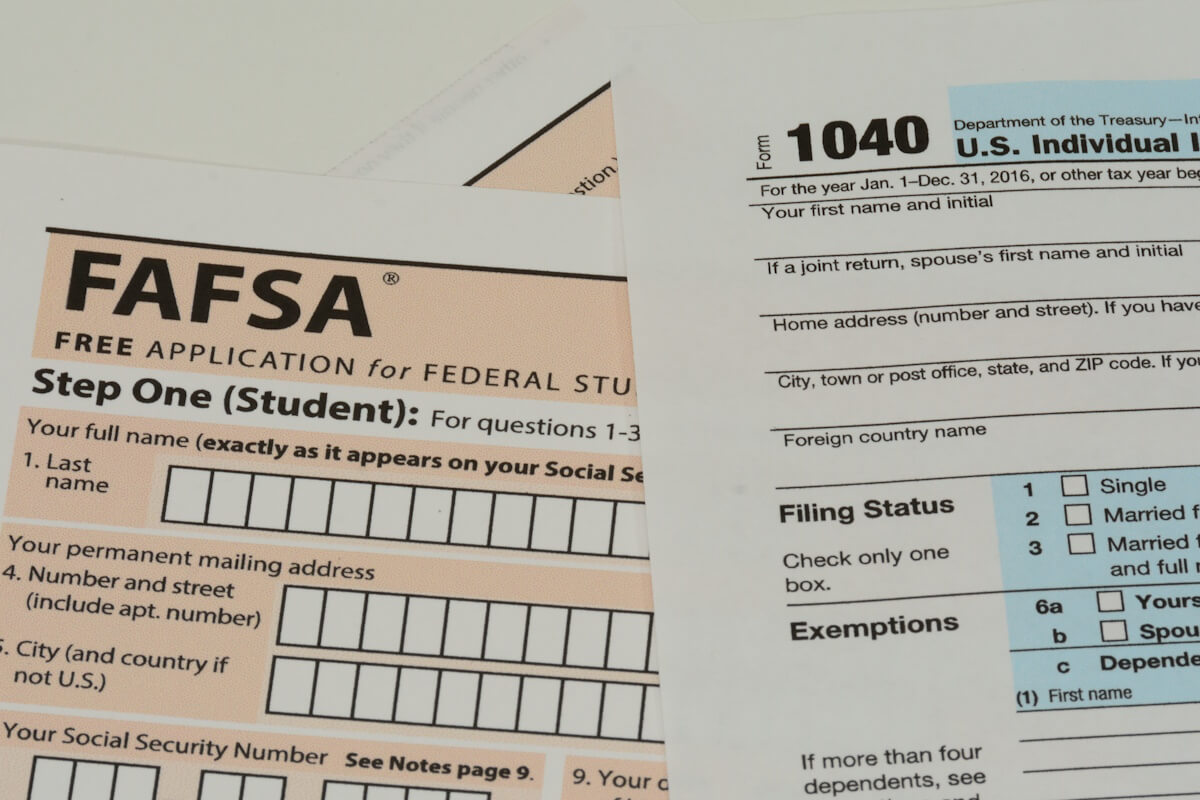
Always complete the FAFSA
No matter your family’s adjusted gross income (AGI), you should fill out the FAFSA. In addition to determining your SAI, the form is required by some financial aid programs and scholarships, even if the award is not based on income level. Completing the FAFSA also tells colleges you’re ready, since many don’t want to grant an admission to someone who may delay for a year. Most students qualify for some form of grants, loans, work/study, or other financial aid. Filing the FAFSA also makes students eligible for Federal Direct Student Loans, and helps parents qualify for Federal Plus loans, which offer the most advantageous terms.
FAFSA Timeline
The FAFSA timeline begins two years before your expected start date; it is when your income is first included to determine your SAI. In October of the year prior to starting college, the window opens to fill out your FAFSA. First, be sure to register for your Federal Student Aid (FSA). The window doesn’t close until the June after your first year of college, but it is recommended to fill out the FAFSA early. Schools and states have a limited amount of student aid available, and some of that student aid is awarded on a first-come, first-served basis. Colleges use the FAFSA to determine your financial aid award letter, which will help you compare school costs during the selection process. You want to try to lower your SAI, if possible.

How To Get the Most Out of the FASFA
Income level is a big part of determining your family’s expected contribution. The FAFSA considers student income and parent income at different levels. For the FAFSA, income is reported for the year two years prior to the school year for which you’re requesting financial aid. (For example, when applying for aid for the 2026-2027 school year, you would submit your 2024 tax return). One of the significant changes for the filing process is that you must import your income directly from the IRS; this will ease the process and eliminate confusion over what income to include.
UPDATE: You must import your income directly from the IRS. This eases the process and eliminates confusion over what income to include.
Parental income has the most significant effect on your SAI. One of the biggest changes to the SAI calculation is how Parental Income is calculated. Parents will be reporting their income (previously used W-2), which means they no longer must report contributions to their employer-sponsored plan. The formula combines the parents’ adjusted gross income, tax-exempt interest, untaxed qualified distributions (Roth IRA withdrawals), deductible non-employer sponsored retirement contributions, and the foreign income exclusion. Parents then get some income offsets in the form of income tax, payroll taxes, and an income protection allowance based on family size.
Since capital gains and stock options count as income, try to avoid excess income until after the student’s sophomore year or try to take it three years before college starts. Consult with a financial advisor early to develop a plan to reduce income during the period counted for the FAFSA.
Reporting assets on the FAFSA
UPDATE: Small businesses and farm owners are now required to report an adjusted net worth of the business or farm, and child support received in the previous year is now listed as an asset.
While student assets and parental assets make up a smaller portion of the SAI, they can significantly reduce the total amount a family is expected to pay. Unlike income, there is no previous time frame considered for assets. Assets, for FAFSA purposes, are counted as of the day you submit the FAFSA. You can move money a week before you file, which will have an impact on the FAFSA. Assets are looked at differently depending upon whether the student or the parent owns them. Student assets increase the SAI by 20% of the total; therefore, every $1,000 in your student’s account increases your ability to pay by $200. Parents use a bracketed scale that goes up to 5.64% of their included asset value; however, not all assets are reportable. Some common assets excluded from the FAFSA:
- Your primary residence
- Qualified retirement accounts (including IRA’s)
- Cash value of life insurance policies
- Qualified annuities

529 Plans and the FAFSA
The 529 plan is a popular college savings tool. It has one of the more interesting relationships with the FAFSA. 529 savings plans can be owned by the parent, the student, or anyone else (i.e., a grandparent). The FAFSA views a self-owned 529 as a student asset, and since that means 20% would be included as SAI, let’s eliminate that and look at the pros and cons of the other two options. If a custodial parent owns the 529, then 5% of the value will go towards the SAI, and distributions don’t count as student income. A non-custodial-owned 529 isn’t included in the asset calculation. Due to a recent change, it no longer counts as income either. This makes transferring ownership to a non-custodial parent the most beneficial when it comes to the FAFSA.
Note: 529s for all children count as parental assets if they are owned by the custodial parent, not just the 529 for the child you are filling out the FAFSA for.
UPDATE: As of this writing, there is no penalty for transferring ownership of a 529 from the custodial parent/student to a non-custodial parent. There has been discussion of this being viewed as a gift for tax purposes. Check with a financial advisor for the latest information. A benefit can be taken advantage of by switching ownership from the parents/student’s name to a trusted adult.
Student Assets: The UGMA and UTMA
Another student asset that is frequently used is the UGMA/UTMA account, owned by the child, and controlled by a custodian. The FAFSA considers the UGMA and UTMA student assets; therefore, 20% of the value will be added to the SAI. Since there is no asset allowance for the student, you could either transfer these student assets to a 529 (reducing from 20% to 5.64% or 0%) or spend down the student assets. Using the assets in this account to purchase a car or computer for school (prior to filing the FAFSA) can increase aid eligibility.
Pro tip: If the student has income, consider putting this in a Roth IRA so it is protected from the FAFSA. It won’t be counted as both income and a student asset.
Also: This article is not responsible for your teenager’s reaction when you inform them that the money in their name must be spent first.

Strategies to Position Parental Assets for the FASFA
Parental assets make up to 5.64% of the SAI. This may seem like a low percentage compared with the other major factors affecting the calculation. But when you add up all your reportable assets, it makes sense to reduce this exposure. The current asset protection allowance is based on the age of the older parent, and whether the household has one or two parents. Still, it’s been reduced significantly and will eventually disappear entirely. With a two-parent household, where the older parent is 48, the allowance is $6,600. Between your checking account, savings account, money market, and emergency fund alone, you can be looking at a couple of thousand dollars per year. The following are ways to help reduce the impact on your Student Aid Index.
Paying down debt can help you in two ways: The FAFSA does not consider debt as an offset to assets unless that asset secures it. Using reportable assets to pay off consumer debt like credit cards, car loans, or prepaying your mortgage lowers the FAFSA’s reportable assets. This is good if you’re paying off credit cards, because you’ll pay less interest in the long run.
Pro tip: Be cautious of using investments to pay off debt because you may incur capital gains. Consult with a financial advisor on the pros and cons of using this strategy.
Timing Matters When Submitting the FASFA
Consider the timing of bigger purchases. Remember, the FAFSA calculates assets as of the day you file. If you plan to a buy a car, replace a roof, do some landscaping, or pay off an outstanding loan, make that payment before the assets are reported. Another timing strategy is to file the FAFSA the day before you receive your paycheck, generally when your checking account is at its lowest balance during the month.
Leveraging Retirement Planning to Benefit Your FASFA Submissions
Increasing contributions to qualified retirement plans can transform reportable assets into non-reportable assets. Maximizing these contributions can significantly affect your reportable assets. Consult with a financial advisor to get an idea of your reportable income for the upcoming year. You can make your Roth IRA or traditional IRA contributions earlier in the year before you file. This is helpful if you’re self-employed or own your own business. If you plan to file the FAFSA in October, you have nine months of earnings for the year already in the books. You could make half your contribution based on your income, and it will decrease your SAI.
Pro tip: Keep in mind that this will only reduce your income for purposes of the FAFSA if you are increasing your contributions to an employer-sponsored plan, but any contribution will reduce the asset side of the calculation.
I’ve provided a few strategies to help maximize eligibility for financial aid, such as grants, federal student aid, and federal direct student loans. Each can help save money heading into this costly endeavor; using them together can help amplify the savings. In times such as these, when the rules can change from year to year, it’s important to consult a financial advisor on the ramifications of these money moves and how they affect your overall goals and financial plan. You can help increase your chances of financial success by creating a plan based on your goals and unique situation—and reviewing it frequently.

Updated March 2026